

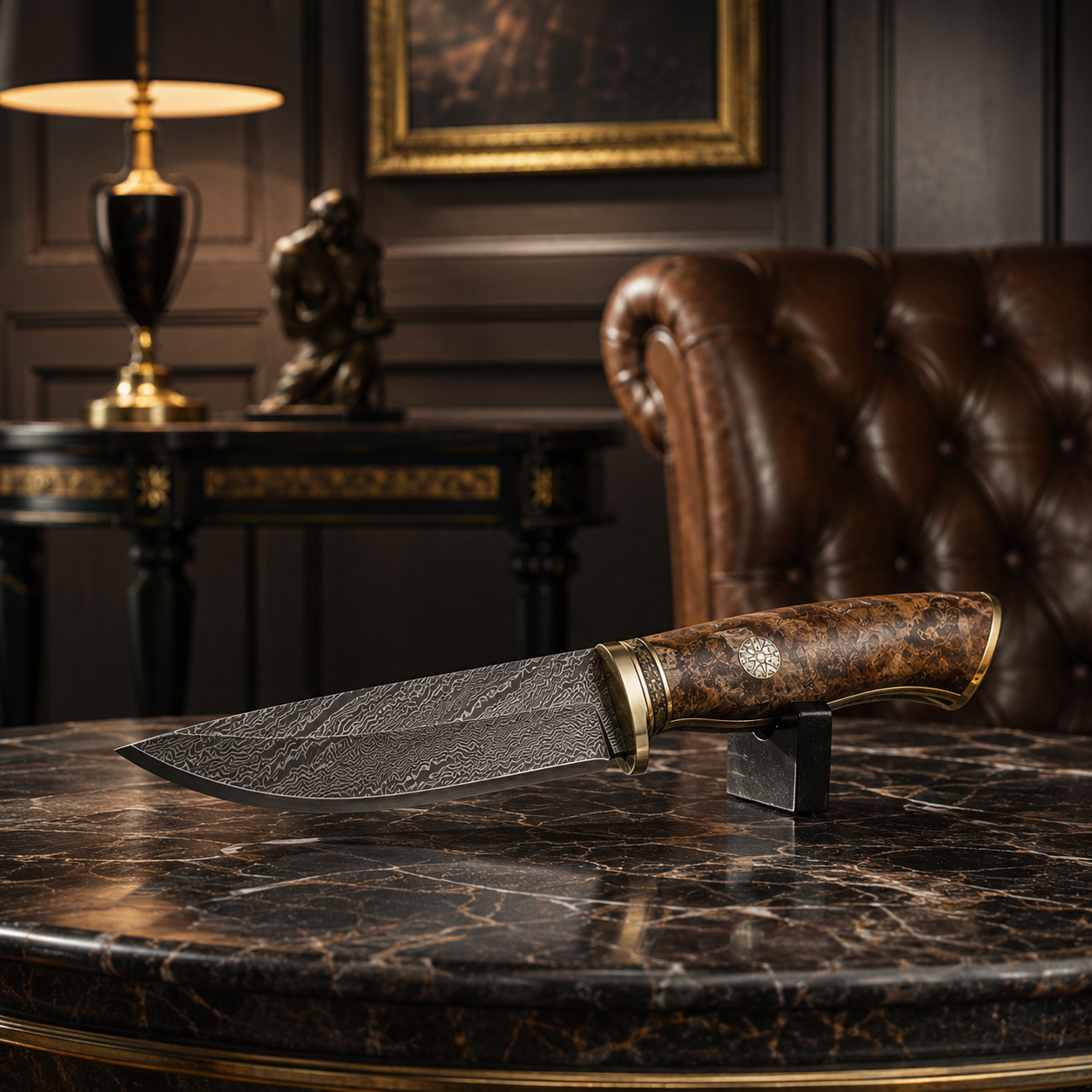
A luxury knife is more than a functional cutting tool. The finest pieces combine thoughtful design, premium materials, skilled craftsmanship, and meticulous finishing into an object that can be appreciated for years.
But what happens between the first idea and the finished knife?
The journey from knife sketch to finished luxury knife involves far more than simply choosing a blade and attaching a handle. Designers must consider proportions, ergonomics, materials, balance, visual character, manufacturing techniques, and countless small details that ultimately determine the quality of the finished piece.
In this guide, we'll explore the complete luxury knife design process, from the initial concept and hand-drawn sketch to material selection, handle making, finishing, assembly, and final quality inspection.
From Sketch to Finished Luxury Knife: The Design Process
1. Every Luxury Knife Begins With an Idea
Before there is a finished knife, there is a concept.
A designer may begin with inspiration from architecture, nature, historical objects, automobiles, traditional craftsmanship, or even a particular material. The goal is to establish the personality of the knife before making technical decisions.
At this stage, designers typically think about:
- The overall silhouette
- Blade and handle proportions
- Intended use
- Handle shape
- Materials
- Decorative elements
- Ergonomics
- Visual style
- Manufacturing techniques
A luxury knife should have a coherent design language. The blade, handle, hardware, and decorative details should look as though they were created as parts of the same object.
This is especially important for designer knives with distinctive handles, where the handle can become the visual centerpiece of the entire piece.

2. Turning the Concept Into a Knife Sketch
Once the basic idea is established, the designer begins creating sketches.
A knife sketch allows proportions and shapes to be explored quickly without committing to expensive materials or manufacturing.
Multiple versions may be drawn before the final concept is selected.
The designer might experiment with:
- Different blade profiles
- Handle lengths
- Handle contours
- Guard shapes
- Bolster designs
- Decorative accents
- Engraving areas
- Material combinations
Even small changes can dramatically alter the appearance of a knife.
A handle that looks elegant in one proportion may appear oversized when paired with a particular blade. Likewise, a blade profile that looks impressive by itself may not work visually with a highly decorative handle.
The sketch is therefore not simply an illustration. It is the beginning of the engineering and design process.
3. Designing for Both Beauty and Function
One of the defining characteristics of a well-designed luxury knife is the balance between aesthetics and usability.
A knife can be visually spectacular, but if its proportions or handle shape are uncomfortable, the design is incomplete.
Ergonomics become particularly important when designing the handle.
The designer considers factors such as:
- How the handle fits in the hand
- Where the fingers naturally rest
- Overall thickness
- Curvature
- Weight distribution
- Surface texture
- Grip characteristics
- Transition between blade and handle
The best designs make these considerations almost invisible.
A well-made luxury knife can look sculptural while still feeling natural and purposeful in the hand.
4. Choosing Materials for a Luxury Knife
Material selection is one of the most important stages in the design process.
The materials influence not only appearance but also weight, durability, texture, machining requirements, and the character of the finished knife.
Premium Handle Materials
Luxury knife handles can be made from a wide range of materials, including:
- Stabilized wood
- Burl wood
- Curly maple
- Ebony
- Walnut
- Micarta
- Carbon fiber
- Titanium
- High-quality composites
- Decorative natural materials
Wood is particularly interesting because every piece has its own grain pattern, color variation, and natural character.
A designer working with burl or figured wood cannot treat every blank as identical. The natural pattern may determine how the handle should be shaped and oriented.
In some cases, the material itself becomes part of the design inspiration.
Blade Materials
The blade material is equally important.
Modern premium knives may use different grades of stainless or tool steel selected for properties such as edge retention, corrosion resistance, toughness, and ease of maintenance.
For a luxury knife, however, performance is only part of the equation. The appearance and finish of the blade also contribute to the overall aesthetic.
5. The Handle Can Become a Work of Art
For many luxury knives, the handle is where the greatest amount of visual creativity appears.
A conventional handle may be primarily functional. A designer luxury knife can treat the handle almost like a small sculpture.
The maker may shape the material to create flowing curves, geometric forms, unusual contours, or decorative silhouettes.
This requires careful material removal.
Too much material removed in one area can destroy the intended proportions. Too little can leave the handle bulky or uncomfortable.
This is why experienced craftsmanship matters.
The final shape often emerges through a combination of measured work, machining, hand shaping, sanding, and visual judgment.
6. From Digital Design to Physical Prototype
Modern knife makers may use both traditional and digital design methods.
A concept can be developed using:
- Hand sketches
- Technical drawings
- CAD software
- 3D modeling
- Physical templates
- Prototype components
Digital modeling is particularly useful for checking proportions before production.
A 3D model can help reveal problems that are difficult to see in a two-dimensional drawing.
However, physical prototyping remains valuable because a computer model cannot completely reproduce the experience of holding the finished object.
A prototype allows the designer to evaluate the actual dimensions, contours, weight, and visual balance.

7. Creating the Blade
Once the design is established, attention turns to the blade.
The manufacturing process varies depending on the knife design and production method, but it generally involves shaping the blade blank, creating the desired geometry, heat treatment, grinding, finishing, and sharpening.
Blade geometry has a major effect on performance and appearance.
The maker must carefully control elements such as:
- Blade thickness
- Edge geometry
- Spine profile
- Grind
- Tip shape
- Surface finish
- Symmetry
Precision is critical because small inconsistencies can become obvious in a high-end finished piece.
8. Heat Treatment and Blade Performance
For appropriate blade steels, heat treatment is a crucial part of the manufacturing process.
The steel is processed under carefully controlled conditions to achieve the desired combination of hardness, toughness, and performance.
This stage is one reason that premium knife production is more complicated than simply shaping a piece of metal.
The final characteristics of the blade depend on both the selected steel and how it is processed.
For collectors and enthusiasts, this behind-the-scenes craftsmanship is often part of what makes a handmade luxury knife interesting.
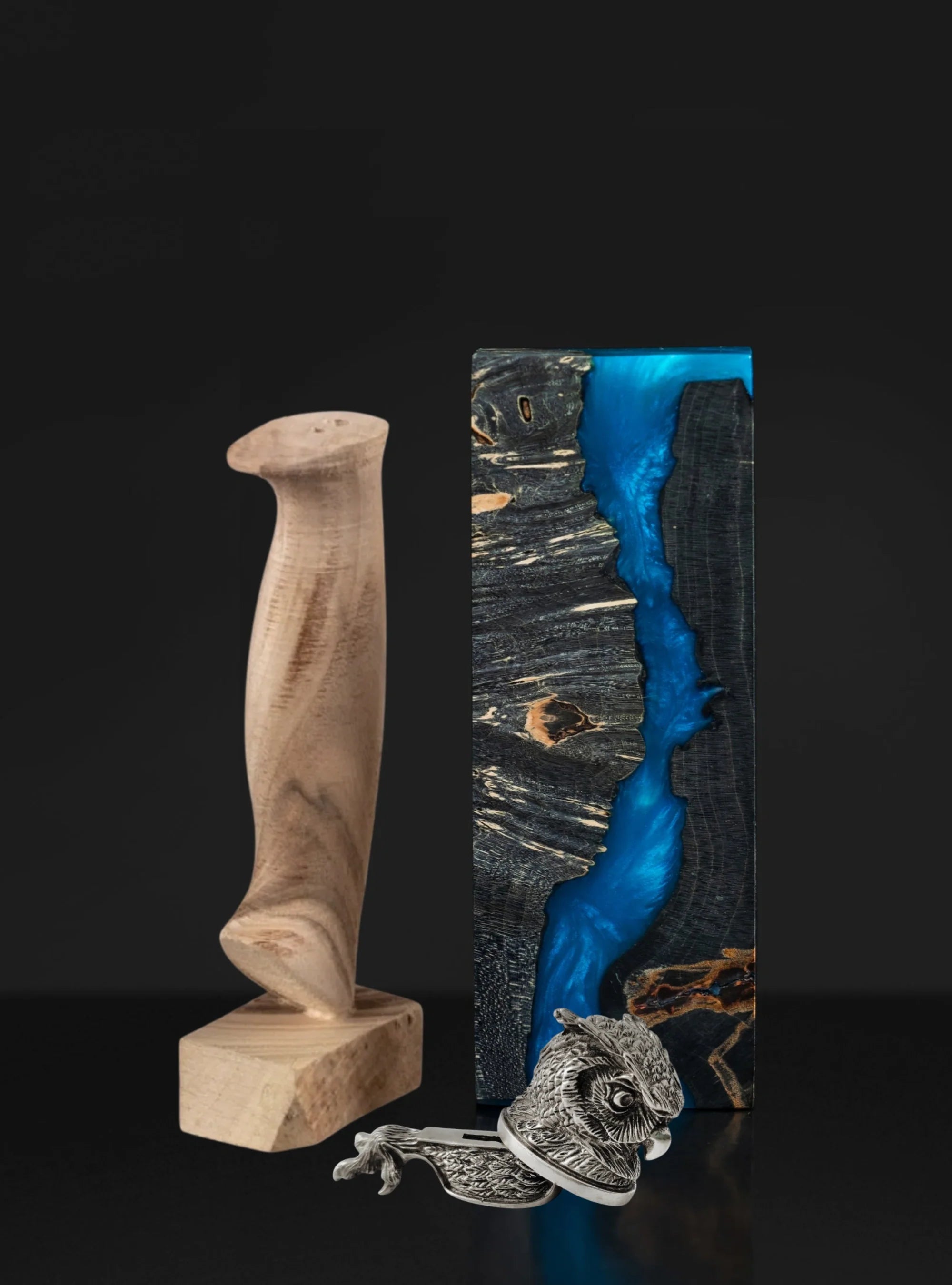
9. Shaping and Refining the Handle
After the handle material has been selected and prepared, the maker begins transforming the blank into its final form.
This is where a simple piece of wood, metal, or composite gradually becomes recognizable as a finished knife handle.
The process can involve:
- Cutting the material to the approximate dimensions
- Creating mounting surfaces
- Establishing the basic profile
- Shaping the contours
- Refining transitions
- Sanding progressively finer surfaces
- Inspecting the symmetry
- Preparing the final finish
For figured wood handles, sanding and finishing can dramatically change the appearance.
As the surface becomes smoother and the finish develops, the grain can become deeper and more visually pronounced.
10. Decorative Details Add Personality
Luxury knife design often involves details that would not be necessary on a purely utilitarian knife.
These details can include:
- Decorative pins
- Bolsters
- Engraving
- Contrasting materials
- Inlays
- Sculpted handle elements
- Custom hardware
- Polished metal accents
The challenge is knowing when to stop.
Luxury design does not necessarily mean adding as many decorative elements as possible.
In many cases, the most sophisticated knives use a relatively simple composition and allow one exceptional material or design element to become the focal point.
11. Hand Finishing Makes the Difference
After machining and shaping, the knife enters one of the most important stages: finishing.
This is where craftsmanship can become particularly visible.
Surfaces may be progressively refined to remove machining marks and create the desired texture or polish.
Depending on the design, the final appearance might be:
- High polish
- Satin
- Matte
- Textured
- Natural wood finish
- Hand-rubbed
- Combination finish
The handle may receive its own finishing process designed to emphasize the natural material while providing an appropriate surface feel.
For luxury knives featuring natural wood, finishing is especially important because it can enhance the grain without making the material look artificial.
12. Assembly Requires Precision
Once the individual components are complete, they must be assembled.
This is another stage where precision matters.
The blade, handle, hardware, and other components need to align correctly.
A high-quality finished knife should have clean transitions and consistent spacing.
The relationship between components is particularly noticeable on a luxury piece because the viewer's eye naturally focuses on details.
A tiny gap, uneven transition, or misaligned component can compromise an otherwise beautiful design.
13. The Final Shape Reveals the Original Design
One of the most satisfying moments in the process is when the individual components finally become one finished object.
At this point, the original sketch can be compared with the completed knife.
The designer can evaluate whether the final piece successfully communicates the original concept.
Does the silhouette look balanced?
Does the handle complement the blade?
Does the material work with the design?
Are the decorative details subtle or dominant?
Does the finished knife feel like a cohesive object?
These questions help distinguish a genuinely considered design from one that simply combines expensive materials.
14. Quality Control Before the Knife Is Finished
A luxury knife should not leave the workshop immediately after assembly.
The finished piece needs to be inspected carefully.
Quality control may include checking:
- Overall symmetry
- Handle construction
- Component alignment
- Surface finish
- Blade condition
- Hardware
- Fit and finish
- Opening and closing action where applicable
- Edge condition
- Overall appearance
The goal is to identify imperfections that may have been missed during individual manufacturing stages.
For handmade products, this final inspection is particularly important because small variations can occur during craftsmanship.
15. Why Handmade Luxury Knives Are Different?
Mass-produced products are generally designed around repeatability and efficiency.
Handcrafted luxury knives follow a different philosophy.
The maker has more opportunity to work with the individual characteristics of the materials and make decisions based on the specific piece being created.
This is especially noticeable with natural handle materials.
Two knives made from the same type of wood can look completely different because no two sections of natural grain are identical.
That individuality is part of the appeal.
A luxury handmade knife can therefore be appreciated not only as a functional object but also as an example of craftsmanship.
16. The Importance of Proportion in Luxury Knife Design
One of the most overlooked aspects of knife design is proportion.
Premium materials alone cannot create an exceptional design.
The relationship between the blade, handle, hardware, and decorative elements needs to feel intentional.
Designers often use visual balance to ensure that no single element overwhelms the rest.
For example, an elaborate handle may require a relatively clean blade design. Conversely, a highly distinctive blade may benefit from a more restrained handle.
This principle is common across luxury product design: quality comes from harmony, not simply from adding more detail.
17. From Sketch to Collectible Object
The transformation from sketch to finished luxury knife is ultimately a combination of creativity and precision.
The process can be summarized as:
Concept → Sketch → Proportion → Material Selection → Prototype → Blade Making → Handle Shaping → Finishing → Assembly → Quality Control
Every stage contributes something different.
The sketch establishes the idea.
The materials establish character.
Craftsmanship creates the physical form.
Finishing reveals the beauty of the materials.
Assembly brings everything together.
Quality control ensures that the finished piece meets the intended standard.
The result is not simply a knife assembled from individual components. It is a carefully developed object in which design, material, and craftsmanship work together.
What Makes a Luxury Knife Truly Special?
A luxury knife is not defined solely by its price or the materials used to make it.
What makes a piece truly special is the thought behind it.
A well-designed luxury knife should have a clear identity. Its proportions should feel intentional. Its materials should complement the design. Its craftsmanship should be visible in the details without overwhelming the overall composition.
The most memorable pieces often combine all of these qualities while retaining a sense of individuality.
That is why the journey from sketch to finished luxury knife matters so much.
Behind every distinctive handle, carefully finished surface, and precisely fitted component is a series of design decisions that began long before the finished knife existed.
Frequently Asked Questions About Luxury Knife Design
How long does it take to design a luxury knife?
The design stage can vary significantly depending on the complexity of the project. A relatively simple design may move from concept to prototype quickly, while highly detailed custom knives can require multiple sketches, prototypes, and revisions.
What makes a knife a luxury knife?
Luxury knives typically combine high-quality materials, sophisticated design, careful craftsmanship, precision manufacturing, and high-quality finishing. Collectibility and limited production can also contribute to their appeal.
What materials are commonly used for luxury knife handles?
Popular materials include figured and stabilized woods, burl wood, ebony, walnut, carbon fiber, titanium, micarta, and other premium materials. Natural materials are especially valued for their unique patterns and individuality.
Why is the knife handle so important?
The handle has a major influence on the knife's appearance, ergonomics, balance, and overall personality. On designer luxury knives, the handle can also serve as the primary artistic element.
Is a handmade knife better than a mass-produced knife?
Not necessarily in every performance category. However, handmade knives can offer distinctive designs, individual material characteristics, detailed finishing, and a level of craftsmanship that appeals strongly to collectors and enthusiasts.
What should you look for when buying a luxury knife?
Consider the quality of the materials, construction, design proportions, handle craftsmanship, blade quality, finishing, maker reputation, and overall fit and finish. A good luxury knife should feel like a cohesive design rather than simply a collection of expensive components.
Final Thoughts
The creation of a luxury knife is a journey that combines design, craftsmanship, materials, precision, and artistry.
What begins as a simple sketch gradually becomes a physical object through dozens of decisions and carefully executed steps. From selecting the right handle material to refining the smallest details, every stage contributes to the final result.
That is what makes a thoughtfully designed luxury knife more than a functional object. It becomes a piece of craftsmanship with its own visual identity and story.
For collectors and enthusiasts, understanding the process behind the finished piece can make the knife even more meaningful. The finished object is only the final chapter of a design journey that began with an idea on paper.
Share:
The Psychology of Collecting Unique Handmade Objects
How to Choose the Perfect Luxury Shoe Horn?