

Not all umbrellas are created equal.
Two umbrellas can look almost identical on a store shelf, yet one may last for years while the other becomes unreliable after only a few rainy days. The difference is usually hidden in the details: the frame, ribs, canopy fabric, handle, stitching, mechanism, and overall construction.
How Do You Know if an Umbrella Is Good Quality?
So, how do you know if an umbrella is good quality?
A good-quality umbrella should feel solid without being unnecessarily heavy, open and close smoothly, maintain its shape when fully extended, use durable materials, and provide reliable protection from rain and wind. The finishing should also be clean, with no loose stitching, weak joints, rough edges, or poorly fitted components.
Whether you are buying a practical everyday umbrella or a luxury handcrafted umbrella, knowing what to inspect can help you make a much better choice.

What Makes an Umbrella Good Quality?
The quality of an umbrella comes from the combination of several components rather than one particular feature.
A well-made umbrella typically has:
- A strong and properly balanced frame
- Durable ribs
- Reliable canopy fabric
- Secure stitching
- A sturdy shaft
- A comfortable handle
- Smooth opening and closing
- Properly fitted components
- Good resistance to everyday weather
- Careful finishing
A high-quality umbrella should also feel intentional. When you hold it, open it, and inspect it closely, the construction should appear consistent rather than improvised.
1. Check the Frame
The frame is one of the most important parts of an umbrella.
The frame supports the canopy and absorbs much of the stress created by wind. If the frame is weak, an attractive canopy cannot compensate for it.
Look at the ribs and the points where they connect to the central shaft.
A quality frame should feel stable when the umbrella is opened. The ribs should move evenly, and there should not be excessive looseness in the joints.
Common frame materials include steel, aluminum, fiberglass, and carbon fiber.
Each has different characteristics.
Steel Frames
Steel can provide excellent rigidity and durability. However, steel components can add weight, which may matter if you carry the umbrella for long periods.
Aluminum Frames
Aluminum is lightweight and can be useful for compact umbrellas. It offers a practical balance between weight and strength.
Fiberglass Frames
Fiberglass is popular in quality umbrellas because it combines strength with flexibility.
Rather than remaining completely rigid under wind pressure, fiberglass components can flex and recover their shape.
Carbon Fiber Frames
Carbon fiber is valued for its high strength-to-weight ratio. It can be particularly attractive in premium umbrellas where reducing weight is important.
The material itself does not automatically determine quality. The design and construction of the complete frame matter just as much.
2. Examine the Ribs
The ribs are the structural arms that spread beneath the canopy.
When inspecting an umbrella, open it fully and look at the ribs.
They should:
- Sit evenly
- Connect securely
- Move smoothly
- Hold the canopy properly
- Have no obvious bends or deformation
- Feel appropriately strong
Pay particular attention to the joints.
These are areas where an umbrella experiences repeated movement and stress. Poorly constructed joints can become loose or damaged over time.
A well-made umbrella should feel balanced when open rather than loose or unstable.

3. Look Closely at the Canopy Fabric
The canopy is the part of the umbrella that protects you from rain.
Quality fabric should look even and well finished.
Check for:
- Consistent material
- Clean stitching
- Secure seams
- No loose threads
- No visible holes
- Even tension
- Proper attachment to the ribs
When the umbrella is fully open, the canopy should form a clean, symmetrical shape.
A sagging or uneven canopy can indicate poor construction.
The fabric should also have an appropriate weight for the intended purpose. Extremely thin material may reduce weight, but durability and long-term appearance can suffer if the fabric is not designed for repeated use.
4. Inspect the Stitching
Stitching is an easy detail to overlook.
It is also one of the simplest ways to identify manufacturing quality.
Look around the canopy seams and the points where the fabric connects to the ribs.
Good stitching should appear:
- Even
- Tight
- Consistent
- Secure
- Free from excessive loose threads
A luxury umbrella should receive particularly careful attention in this area because craftsmanship is part of what distinguishes a premium product.
Small details become important when an umbrella is expected to last for many years.
5. Test the Opening Mechanism
A quality umbrella should open smoothly.
Whether the umbrella is manual or automatic, the mechanism should not require excessive force or feel rough.
When testing an umbrella, pay attention to:
- Smooth movement
- Consistent resistance
- Locking mechanism
- Closing action
- Shaft movement
- Overall stability
For an automatic umbrella, the opening mechanism should operate decisively without feeling excessively violent or uncontrolled.
For a manual umbrella, the runner should move smoothly along the shaft.
If an umbrella feels awkward or catches during opening when it is brand new, that may be a warning sign.
6. Pay Attention to the Shaft
The shaft connects the handle to the canopy and plays an important structural role.
A good shaft should feel straight, secure, and appropriately rigid.
When the umbrella is open, the shaft should not appear excessively loose or misaligned.
On a folding umbrella, examine each telescoping section carefully. The sections should fit together properly without excessive play.
On a full-length umbrella, the shaft can also contribute significantly to the overall balance and traditional appearance.
7. Evaluate the Handle
The handle is where you physically interact with the umbrella, so comfort matters.
A good handle should feel secure in your hand and should not have rough edges or poorly finished surfaces.
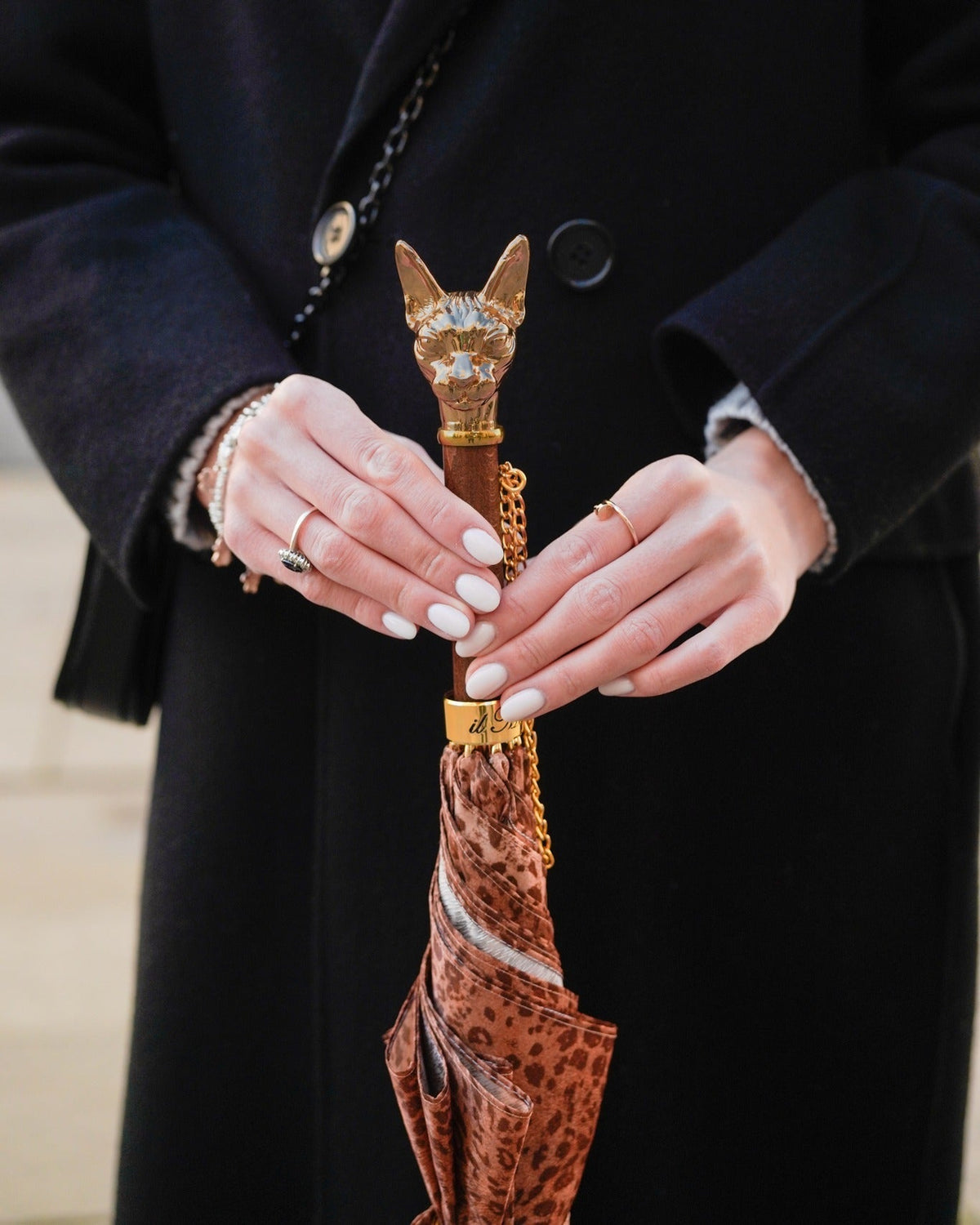
Luxury umbrellas often use materials such as:
- Natural wood
- Leather
- Metal
- High-quality composites
Natural wooden handles can be especially attractive because each piece can have a unique grain pattern.
A well-finished wooden handle should feel smooth and comfortable rather than rough or unfinished.
The shape also matters.
A beautiful handle that is uncomfortable to hold is not necessarily a high-quality design.
8. Check the Overall Balance
Pick up the umbrella.
Does it feel balanced?
This simple test can tell you a surprising amount.
A quality umbrella should not feel awkwardly weighted toward the handle or canopy. The components should work together to create a comfortable carrying experience.
This becomes particularly important for a full-length umbrella that you may carry for extended periods.
Balance is one of those characteristics that is difficult to describe on a specification sheet but immediately noticeable in your hand.
9. Consider Wind Resistance
A quality umbrella should be designed to cope with ordinary wind rather than simply looking attractive on a calm day.
Wind puts stress on the canopy, ribs, joints, and shaft.
Some umbrellas use flexible fiberglass ribs or other structural approaches to help manage wind pressure.
However, be careful with exaggerated marketing claims.
No ordinary umbrella should be considered indestructible. Very strong winds can damage or invert almost any umbrella.
Instead of looking for an umbrella that claims to be “unbreakable,” examine the actual construction.
Look for:
- Flexible ribs
- Strong joints
- Secure canopy attachments
- Durable shaft
- Quality frame materials
- Thoughtful overall engineering
A well-designed umbrella should recover from normal wind stresses better than a poorly constructed one.
10. Look at the Canopy Shape
Open the umbrella and step back.
Does the canopy look symmetrical?
The shape should generally appear clean and evenly tensioned.
Poorly made umbrellas can sometimes show uneven sections or fabric that hangs differently from one side to another.
A quality canopy should maintain its intended shape when fully opened.
This is both a visual and functional consideration.
A properly shaped canopy can provide more consistent rain protection while also looking significantly more refined.
11. Check the Metal Components
Small metal components can reveal a lot about an umbrella's construction.
Inspect:
- Rivets
- Springs
- Joints
- Connectors
- Shaft components
- Tips
- Ferrules
They should appear properly fitted and finished.
There should not be obvious sharp edges, excessive corrosion, loose components, or poorly aligned parts.
On a premium umbrella, these details should complement the overall craftsmanship.
12. Consider the Umbrella's Weight
Heavier does not automatically mean better.
A very heavy umbrella may contain substantial materials, but that does not necessarily mean it is stronger or more durable.
The goal is an appropriate balance between strength and weight.
For daily commuting, a lightweight umbrella can be much more practical.
For a traditional full-length luxury umbrella, some additional weight may be acceptable if it contributes to a solid, balanced construction and comfortable handling.
Ask yourself how you will actually use the umbrella.
The best umbrella is one that you will comfortably carry.
13. Look at the Finish
Finishing quality is particularly important when buying a luxury umbrella.
Run your hand carefully over the handle and inspect the visible components.
Look for:
- Smooth surfaces
- Clean edges
- Consistent finishes
- Even polishing
- Secure fittings
- No rough areas
A handcrafted wooden handle, for example, should be carefully shaped and finished so that it feels smooth and comfortable in the hand.
These details may not affect whether an umbrella opens, but they strongly affect the experience of owning it.
14. Consider Whether It Is Made to Last
A quality umbrella should be designed with repeated use in mind.
Ask yourself:
Is this umbrella designed to be replaced quickly, or is it designed to be used for years?
Look beyond the packaging and advertising.
Examine the materials and construction.
A durable umbrella should be capable of handling repeated opening and closing, regular carrying, exposure to rain, and ordinary outdoor conditions.
This is especially important if you are purchasing a luxury umbrella. A premium price should ideally correspond to meaningful improvements in materials, construction, craftsmanship, or longevity.
Compact vs. Full-Length Quality
The same quality principles apply to both compact and full-length umbrellas, but there are differences worth considering.
Compact Umbrellas
Compact umbrellas prioritize portability.
Because they fold into several sections, they have more moving and connecting components.
When buying one, pay particular attention to:
- Telescoping shaft
- Folding joints
- Rib connections
- Opening mechanism
- Folded size
- Weight
A compact umbrella should still feel stable when fully opened.
Full-Length Umbrellas
Full-length umbrellas generally have a simpler structural design.
They can offer:
- Larger canopies
- Traditional proportions
- Comfortable handles
- Stronger visual presence
- Excellent coverage
They are particularly suitable for people who prioritize craftsmanship and classic style.
Neither type is inherently higher quality.
The right choice depends on how you intend to use the umbrella.
What Is the Best Material for a Quality Umbrella?
There is no single best material.
Different materials provide different advantages.
Fiberglass: Flexible and resilient, making it useful for umbrella ribs and frames.
Carbon fiber: Lightweight and strong, particularly suitable for premium lightweight construction.
Steel: Strong and rigid but generally heavier.
Aluminum: Lightweight and useful for portable umbrella designs.
Natural wood: Attractive, tactile, and particularly suitable for handcrafted handles and traditional full-length umbrellas.
The quality of the finished umbrella depends on how these materials are selected and combined.
How Do You Know if a Luxury Umbrella Is Actually High Quality?
Luxury does not automatically mean high quality.
A premium-looking umbrella can still have weak construction.
When evaluating a luxury umbrella, look for evidence of craftsmanship rather than relying on appearance or price alone.
Ask:
- Are the materials clearly specified?
- Is the construction carefully finished?
- Does the frame feel strong?
- Are the joints secure?
- Is the canopy evenly constructed?
- Is the handle comfortable?
- Does the umbrella open smoothly?
- Is there attention to small details?
- Does the manufacturer explain how the umbrella is made?
A genuine luxury umbrella should have substance behind the presentation.
Common Signs of a Poor-Quality Umbrella
Sometimes it is easier to identify a bad umbrella than a good one.
Be cautious if you notice:
- Loose stitching
- Uneven canopy sections
- Excessive movement in the shaft
- Weak or loose ribs
- Rough handle surfaces
- Poorly fitted metal components
- Difficult opening
- Excessive rattling
- Uncomfortable grip
- Extremely flimsy construction
- Strong chemical odor
- Obvious manufacturing defects
One problem may not necessarily mean the entire umbrella is poor quality, but several warning signs together should make you reconsider the purchase.
Does a More Expensive Umbrella Mean Better Quality?
Not always.
Price and quality are related, but they are not identical.
A more expensive umbrella may use better materials, more careful craftsmanship, advanced engineering, or a distinctive design.
But you should still evaluate the actual product.
A good buying principle is:
Pay for better construction, not simply a higher price tag.
If two umbrellas have similar construction but one costs considerably more because of branding alone, the more expensive option may not provide better practical value.
How to Test an Umbrella Before Buying?
If you can physically inspect the umbrella before purchasing, perform a simple quality check.
Open It
Make sure the canopy opens evenly and locks securely.
Look at the Canopy
Check for symmetrical shape, clean stitching, and loose threads.
Examine the Ribs
Make sure they are properly aligned and securely connected.
Hold the Handle
Evaluate comfort and finish.
Move the Shaft
It should feel appropriately stable rather than excessively loose.
Close It
The umbrella should collapse smoothly without catching or requiring unusual force.
These simple checks can reveal problems that are difficult to see in product photographs.

How to Choose a Quality Umbrella Online?
Buying online requires a slightly different approach.
Since you cannot physically hold the umbrella, look for detailed product information.
Pay attention to:
- Dimensions
- Weight
- Materials
- Frame construction
- Canopy fabric
- Handle material
- Opening mechanism
- Warranty information
- Product photographs
- Customer reviews
High-quality product photography can also help you inspect details such as stitching, handle finishing, and frame construction.
Avoid listings that provide almost no information about how the umbrella is constructed.
A quality manufacturer should be able to explain what makes its product different.
How to Care for a Quality Umbrella?
Even the best umbrella can deteriorate if it is stored incorrectly.
The most important habit is simple:
Always allow your umbrella to dry before storing it for an extended period.
After using it in the rain, open it in a suitable sheltered area and allow the canopy to dry naturally.
Also:
- Avoid forcing the umbrella open
- Do not leave it compressed while soaking wet
- Keep the canopy clean
- Inspect the frame periodically
- Store it in a dry location
- Use the protective sleeve when appropriate
Proper care helps preserve both appearance and performance.
A Simple Quality Umbrella Checklist
Before buying, use this quick checklist:
Canopy: Is the fabric durable, evenly tensioned, and well stitched?
Frame: Does the structure feel strong and properly assembled?
Ribs: Are the ribs aligned and securely connected?
Shaft: Does it feel straight and stable?
Handle: Is it comfortable and smoothly finished?
Mechanism: Does it open and close without problems?
Weight: Is it appropriate for your intended use?
Wind resistance: Is the construction designed to handle normal wind?
Craftsmanship: Are the small details carefully finished?
Durability: Does the umbrella appear designed for repeated use?
If an umbrella performs well across all ten categories, you are likely looking at a quality product.
Final Thoughts
So, how do you know if an umbrella is good quality?
Start by looking beyond its appearance.
Examine the frame, ribs, canopy, stitching, shaft, handle, opening mechanism, and finishing. Consider the materials and how they are combined. Think about how much you will carry the umbrella and the type of weather it will encounter.
A truly good umbrella should feel reliable in your hand and look carefully constructed when you inspect it closely.
For everyday use, prioritize durability, comfortable handling, practical weight, and weather resistance. For a luxury umbrella, add craftsmanship, refined materials, distinctive design, and exceptional finishing to that list.
The best umbrella is not necessarily the most expensive one.
It is the one whose materials, construction, performance, and craftsmanship justify the confidence you place in it every time you step outside.
Frequently Asked Questions
How can you tell if an umbrella is good quality?
Check the frame, ribs, canopy fabric, stitching, shaft, handle, and opening mechanism. A quality umbrella should feel stable, open smoothly, have clean stitching, and show careful attention to construction and finishing.
What is the most important part of an umbrella?
The frame is one of the most important components because it supports the canopy and absorbs stress from wind. However, overall quality depends on the frame, canopy, shaft, handle, and construction working together.
Is fiberglass good for an umbrella?
Yes. Fiberglass is commonly used in quality umbrellas because it combines strength with flexibility. Flexible fiberglass ribs can help an umbrella cope with normal wind stresses.
Is carbon fiber good for umbrellas?
Yes. Carbon fiber offers a high strength-to-weight ratio and can be particularly useful for lightweight premium umbrellas.
Are expensive umbrellas better?
Not automatically. A higher price can reflect better materials, craftsmanship, engineering, or design, but price alone does not guarantee quality. Always evaluate the actual construction.
How long should a good-quality umbrella last?
There is no universal lifespan because durability depends on construction, weather conditions, frequency of use, and care. A well-made umbrella should generally be designed for repeated use rather than quick replacement.
Is a heavy umbrella better?
No. Weight alone is not an indicator of quality. A well-designed lightweight umbrella can be strong and durable, while an unnecessarily heavy umbrella may simply be inconvenient to carry.
What should I look for when buying a luxury umbrella?
Look for high-quality materials, strong frame construction, secure stitching, a comfortable handle, smooth operation, thoughtful design, and careful finishing. Luxury should be reflected in the construction and craftsmanship, not only the price or branding.
Share:
The Best Luxury Umbrellas for Everyday Use
Are Wooden Handle Luxury Umbrellas Better?